Key Scientific Findings
The Hidden Scale and Persistence
Forest Degradation affects large areas around the globe and can persist for years. According to Our World in Data, forest degradation makes up the majority of global tree loss, far more than even deforestation. This is driven in part by logging roads, fire, and other disturbances that fragment remaining intact forests, eroding biomass, resilience, and ecosystem function even where tree cover remains. Recent research in the Brazilian Amazon also shows that deforestation-focused policies do not necessarily reduce degradation, underscoring why forest risk cannot be managed through “no-deforestation” commitments alone.
Takeaway: Forest degradation is more extensive than deforestation, but it is less visible and therefore very under-managed.
Large portions of global forests show measurable signs of degradation.
Degradation is under-measured and underreported globally, so outside the Amazon, visibility is reduced.
Degradation frequently precedes and increases vulnerability to later conversion.
Deforestation policies and commitments may miss degradation unless they explicitly address drivers such as fire, logging, and fragmentation.

Source: Matricardi, E.A.T., Skole, D.L., Costa, O.B., Pedlowski, M.A., Samek, J.H., & Miguel, E.P. (2020). Long-term forest degradation surpasses deforestation in the Brazilian Amazon. Science, 369(6509), 1378–1382. https://doi.org/10.1126/science.abb3021
Forest Function and Carbon Impacts
Even where satellite maps still label areas as “forest,” degradation reduces forest functioning—from maintenance of canopy height and biomass to dry-season evapotranspiration—and can drive substantial carbon emissions. In the Amazon, for example, annual emissions from degradation are comparable to, and sometimes greater than, those from deforestation.
Takeaway: Forests can keep their “cover” but lose value and stability, with real implications for climate, water, biodiversity, and market risk.
Wildfire and even selective logging and fire cause long-lasting declines in canopy structure and biomass.
Carbon losses from degradation and disturbance account for a large, often hidden share of forest emissions.
Functional declines (water cycling, habitat quality) raise operational and supply-chain risk even without land-use conversion.

Source: Matricardi, E.A.T., Skole, D.L., Costa, O.B., Pedlowski, M.A., Samek, J.H., & Miguel, E.P. (2020). Long-term forest degradation surpasses deforestation in the Brazilian Amazon. Science, 369(6509), 1378–1382. https://doi.org/10.1126/science.abb3021
Wildfire Risk
Degradation—through intensive logging, dense even-aged plantations, fragmentation, and road building—changes how forests burn. Recently cleared areas and logging slashpiles dry quickly; uniform stands create continuous fuels; and new roads bring human-caused ignitions. These shifts make fires easier to start and more likely to burn severely, especially during drought or heat waves.
Takeaway: Degradation often raises wildfire likelihood and severity, while well-placed fuel management near communities can reduce risk.
Open canopies + slash → faster fuel drying and higher wind penetration.
Homogeneous, even-aged stands → continuous, more flammable fuels.
Roads and Wildland-Urban Interface (WUI) expansion → more human-caused ignitions and faster fire spread.
What can help: Prescribed/cultural burning, strategic thinning near communities, mixed-species/longer-rotation stands, maintained fuel breaks and defensible space.

Source: Natural Resources Defense Council. Forest Degradation in Canada – R_25-04-A_05. April 2025.
Flood and Erosion Risk
Degradation alters soils and hydrology. Clearcuts, skid trails, and compacted harvest areas reduce infiltration and increase overland flow; roads and stream crossings add chronic sediment and can fail in intense storms. The result can be higher peak flows and erosion in small-to-midsize watersheds, with the strongest effects in the first years after harvest and on steep or rain-on-snow terrain.
Takeaway: Degradation can increase flood peaks and sediment delivery, elevating risks to communities and infrastructure; management choices matter.
Post-harvest: higher storm runoff and peak flows can occur, as well as lower late-summer base flows.
Roads and crossings → major sediment sources; culverts can fail during extremes.
Steep slopes, erodible soils, and rain-on-snow events amplify impacts.
What can help: Limited road density, avoiding logging in high-risk areas like steep slopes that increase erosion, decommissioning or relocating high-risk roads, upsizing culverts for extreme rainfall, retaining riparian buffers, seeding/mulching disturbed soils and re-vegetating quickly.

Source: Courtenay Lewis for NRDC. Forest Degradation in Canada – R_25-04-A_05. April 2025.
Biodiversity and Habitat Risk
Degradation fragments habitat and simplifies forest structure. Logging and road networks can reduce crucial “forest legacies” (like logs, snags, and other woody debris) that many species depend on, thereby shifting wildlife communities even where overall forest cover appears unchanged.
Takeaway: Degradation can drive species declines and ecosystem instability without deforestation, making biodiversity loss a hidden, cumulative risk.
Boreal caribou: Younger post-logging forests attract moose/deer/elk, increasing predators; roads further increase predator movement and hunting success. The Canadian Boreal Caribou Federal Recovery Strategy points to at least 65 percent undisturbed habitat as a key benchmark for long-term persistence.
Birds: In the Maritime Acadian forests, degradation has been linked to habitat declines for many forest birds; old forest declined 39 percent between 1985 and 2020, and researchers estimate that 30 million to 100 million birds have been lost since 1985.
Fragmentation: For the marbled murrelet, predation risk is higher near clearcuts and roads and in fragmented landscapes; the species lost over 20 percent of its habitat over three generations.
Dead wood matters: Woody debris supports nutrient cycles and provides habitat/food for many organisms; in British Columbia’s interior, about one-third of forest vertebrates depend on these structures, yet logging removes them at scale. In fact, clearcuts often leave as little as one-third the amount of coarse woody debris as wildfire-affected areas.
What can help: Maintaining forest structure by sustaining at least half of naturally occurring down wood at the landscape level and keeping a range of sizes/decay classes.
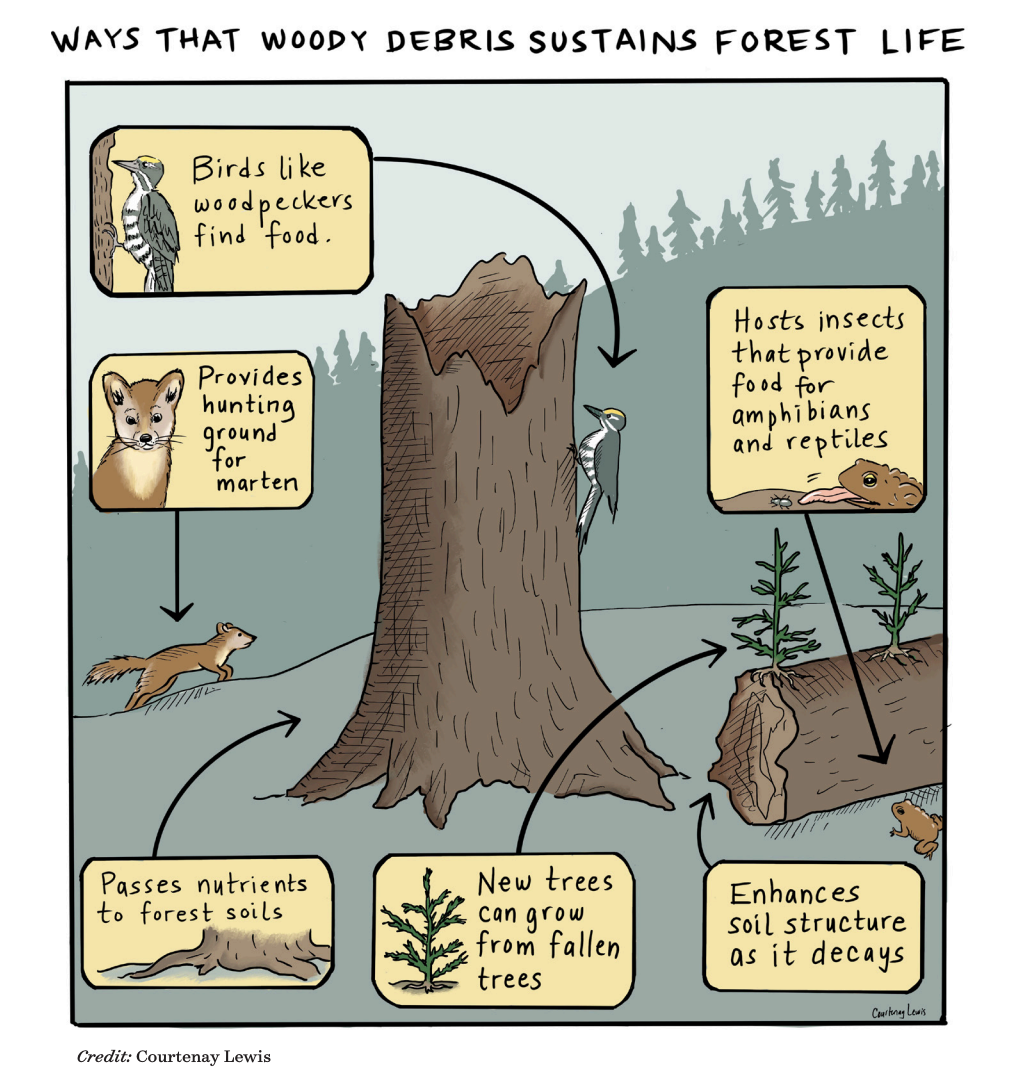
Source: Natural Resources Defense Council. Forest Degradation in Canada – R_25-04-A_05. April 2025.
Key Research
Government/System-Risk Assessments
UK Government, “Nature Security Assessment: Global Biodiversity Loss, Ecosystem Collapse and National Security,” UK Government, 2026 — Frames accelerating biodiversity loss and ecosystem collapse as national security risks, including implications for geopolitical stability, supply chains, and domestic resilience. (GOV.UK)
World Economic Forum, “Global Risks Report 2026,” World Economic Forum, 2026 — Ranks biodiversity loss and ecosystem collapse among the most severe global risks over the next decade, reinforcing a “systems risk” framing relevant for investors and policymakers. (World Economic Forum)
Partha Dasgupta, “The Economics of Biodiversity: The Dasgupta Review,” HM Treasury, 2021 — Landmark economic assessment arguing that nature is an underpriced and under-accounted asset in modern economies and that failure to account for natural capital degradation creates systemic economic risk. (GOV.UK)
IPBES, “Global Assessment Report on Biodiversity and Ecosystem Services,” Intergovernmental Science-Policy Platform on Biodiversity and Ecosystem Services, 2019 — Comprehensive synthesis documenting widespread degradation of nature and escalating risks to biodiversity and human well-being without transformative policy and economic change. (IPBES)
IPBES, “Nexus Assessment of Biodiversity, Water, Food, Health and Climate,” Intergovernmental Science-Policy Platform on Biodiversity and Ecosystem Services, 2024 — Highlights how degradation across biodiversity, water, food, health, and climate systems creates compounding risks and requires integrated policy responses. (IPBES)
Global Tracking and Degradation Scale
Forest Declaration Assessment, “Forest Declaration Assessment 2025,” Forest Declaration Assessment, 2025 — Reports that deforestation and degradation remained high in 2024 and estimates roughly 8.8 million hectares of tropical moist forest degradation globally that year, undermining ecosystem integrity and resilience.(Forest Declaration Assessment)
World Resources Institute, “Fires Drove Record-Breaking Tropical Forest Loss in 2024,” Global Forest Review, 2025 — Reports 6.7 million hectares of primary rainforest lost in 2024 (the highest level in at least two decades), highlighting how fire-driven degradation and loss are accelerating under hotter and drier conditions. (gfr.wri.org)
Hannah Ritchie and Max Roser, “Not all forest loss is equal: what is the difference between deforestation and forest degradation?,” Our World in Data, 2021 — Synthesizes global forest loss drivers based on Curtis et al. classifications, showing that only about one-quarter of global forest loss is permanent deforestation while the remainder is largely driven by degradation processes such as forestry, shifting agriculture, and wildfire. (Our World in Data)
Nancy L. Harris et al., “Global maps of twenty-first century forest carbon fluxes,” Nature Climate Change, 2021— Produces high-resolution global maps of forest carbon removals and emissions from deforestation and other disturbances, showing the scale of gross forest carbon fluxes worldwide. (Nature Climate Change)
Canada Focused Research (Degradation, de Facto Deforestation, Accounting Gaps)
Nature Canada, “Logging Emerges as Canada’s Third-Largest Climate Polluter,” Nature Canada, 2024 — Argues that logging is a major and under-recognized emissions source, estimating roughly 147 Mt CO₂ emissions in 2022 and positioning forestry as Canada’s third-largest emitting sector after oil & gas and transportation. (Nature Canada)
David Bysouth et al., “High emissions or carbon neutral? Inclusion of ‘anthropogenic’ forest sinks leads to underreporting of forestry emissions,” Frontiers in Forests and Global Change, 2024 — Finds that official forest carbon reporting mischaracterizes forestry emissions by classifying substantial harvest-related carbon losses as “natural,” significantly understating the climate impact of logging.(Frontiers)
State of the Forest Coalition, “The State of the Forest in Canada,” 2024 — A site that synthesizes evidence on degradation impacts including road expansion, habitat fragmentation, and misleading “carbon neutral” narratives associated with industrial logging. (State of the Forest in Canada)
Brendan Mackey et al., “Assessing the Cumulative Impacts of Forest Management in Ontario and Quebec, Canada: Are They Degrading or Emulating Natural Forest Disturbance?,” Land, 2024 — Documents cumulative ecological degradation resulting from decades of industrial logging and development in Ontario and Quebec. (Land)
Wildlands League, “Logging Scars: Mapping the Legacy of Industrial Logging in Ontario,” Wildlands League, 2019 (supplement 2020) — Uses site-level evidence to document roads, landings, and persistent “barren scars,” showing substantially greater forest disturbance than reflected in official reporting. (Wildlands League)
Matthew G. Betts et al., “Forest degradation drives widespread avian habitat and population declines,” Nature Ecology & Evolution, 2022 — Shows that forest degradation contributed to habitat declines for the majority of forest bird species in eastern Canada, with particularly strong impacts on species associated with older forests. (Nature Ecology & Evolution)
Jeff Bowman et al., “Roads, logging, and the large-mammal community of an eastern Canadian boreal forest,” Canadian Journal of Zoology, 2010— Examines how roads and logging reshape large-mammal distributions in an eastern Canadian boreal forest, with implications for fragmentation-sensitive species such as woodland caribou. (Canadian Journal of Zoology)
Additional Peer-Reviewed Research Papers
Linyan Yu et al., “Forest degradation contributes more to carbon loss than forest cover loss in North American boreal forests,” Remote Sensing of Environment, 2024— Finds that carbon losses from degradation can exceed those from forest cover loss in boreal forests, highlighting the importance of degradation beyond tropical contexts. (ScienceDirect)
Daniel B. Tinker and Dennis H. Knight, “Coarse Woody Debris following Fire and Logging in Wyoming Lodgepole Pine Forests,” Ecosystems, 2000 — Finds that, in Wyoming lodgepole pine forests, timber harvesting removes much of the coarse woody debris left by natural disturbance, reducing important structural habitat elements. (Ecosystems)
Mathieu Bouchard and David Pothier, “Long-term influence of fire and harvesting on boreal forest age structure and forest composition in eastern Québec,” Forest Ecology and Management, 2011 — Documents major declines in forests older than 60 years across eastern Quebec during the twentieth century due to expanding harvest areas. (Forest Ecology and Management)
Robbie S.H. Johnson and Y. Alila, “Investigating forest harvesting effects on floods in two large, nested, and snow-dominated watersheds in British Columbia, Canada,” Journal of Hydrology, 2023 — Finds that forest harvesting significantly increases flood magnitude and frequency, with impacts intensifying as flood events become larger and watersheds expand. (Journal of Hydrology)
Chiara Vergani et al., “Root reinforcement dynamics in subalpine spruce forests following timber harvest: a case study in Canton Schwyz, Switzerland,” Catena, 2016 — Shows that root reinforcement in harvested spruce forests declines rapidly after logging, increasing slope instability and landslide risk. (Catena)
Fumitoshi Imaizumi et al., “Effects of forest harvesting on the occurrence of landslides and debris flows in steep terrain of central Japan,” Earth Surface Processes and Landforms, 2008 — Finds landslide volumes were roughly four times higher in clear-cut areas and that elevated landslide risk persisted for decades after harvesting. (Earth Surface Processes and Landforms)
Eraldo A.T. Matricardi et al., “Long-term forest degradation surpasses deforestation in the Brazilian Amazon,” Science, 2020 — Demonstrates that forest degradation in the Amazon can affect larger areas than deforestation and has major implications for carbon storage and biodiversity. (Science)
Kenneth V. Rosenberg et al., “Decline of the North American avifauna,” Science, 2019 — Documents widespread population declines of birds across North America, showing that ecosystem-scale losses of individuals are occurring across multiple habitat types. (Science)
Additional Illustrations
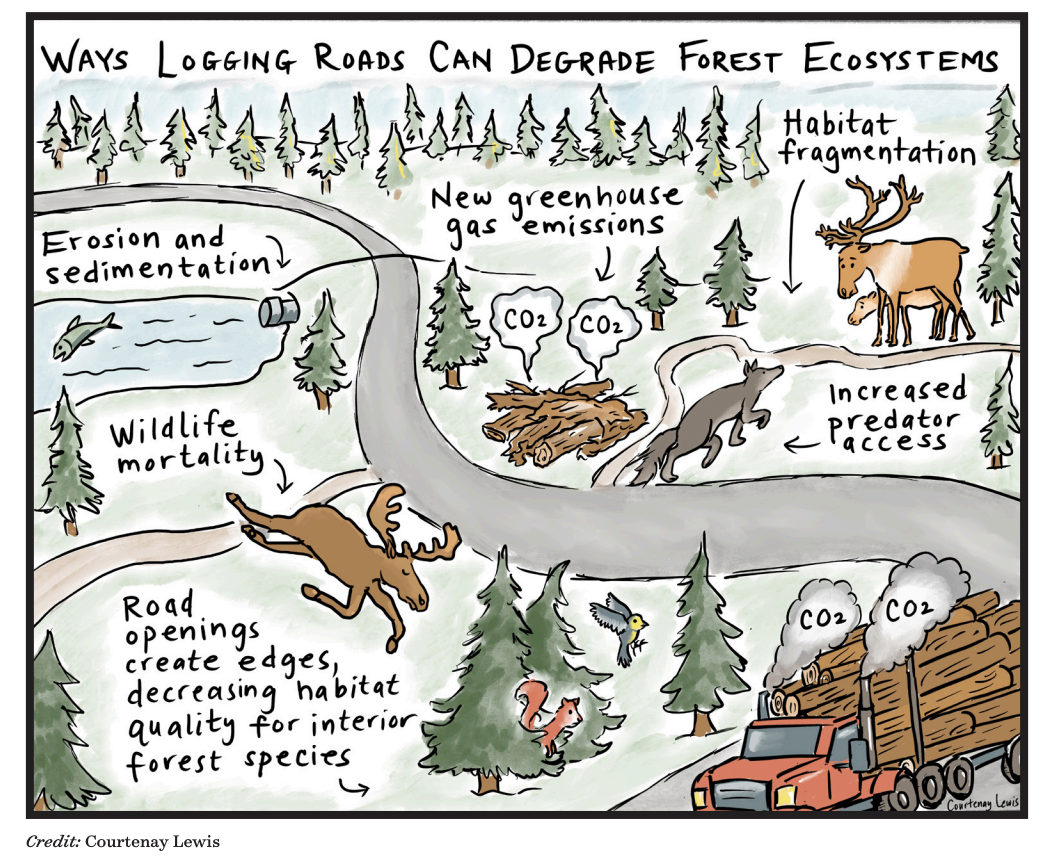
Ways Logging Roads Can Degrade Forest Ecosystems. Credit: Courtenay Lewis for NRDC
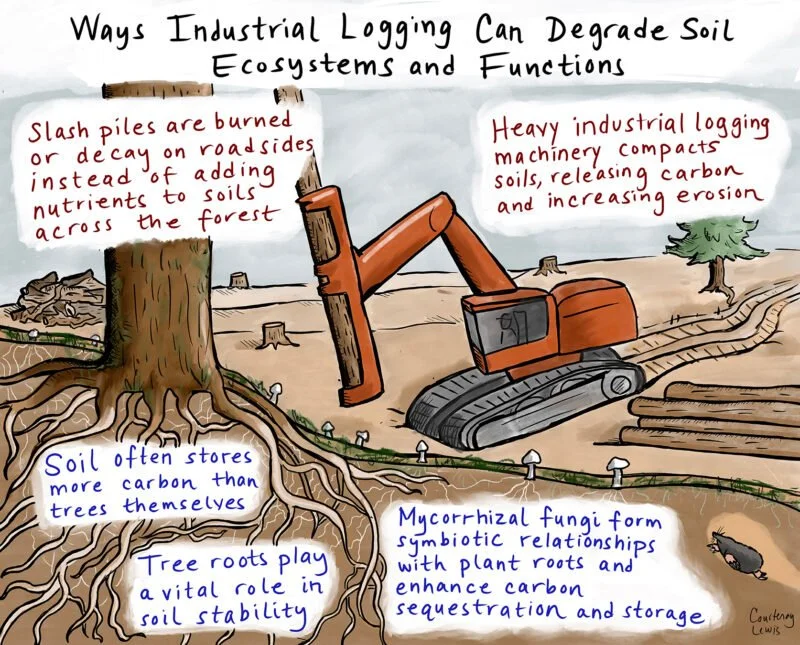
Ways Industrial Logging Can Degrade Soil Ecosystems and Functions. Credit: Courtenay Lewis for NRDC

Habitat Fragmentation. Credit: Courtenay Lewis for NRDC