
Degradation Risk Value Chain Map
Forest degradation risk across the value chain
Degradation happens on the land, but decisions across logging, processing, and retail shape risk — with finance and governance influencing every step.
Where on-the-ground practices drive the most direct degradation outcomes.
- Road-building and fragmentation reduce forest integrity and resilience.
- Impacts to soil and hydrology reduce regeneration, increase failure risk over time, and contribute to broader environmental risks like flooding and carbon emissions.
- Simplifying diverse stands (including via plantation-style management, where relevant) reduces habitat quality and ecological function.
More detail
Other vulnerabilities
- Road expansion increases drying and wind exposure and disrupts habitat along new forest edges.
- Rights and consent failures — including failure to obtain the Free, Prior and Informed Consent (FPIC) of Indigenous Peoples — create conflict, delays, and legal or reputational exposure.
Where procurement choices and fiber mixing can obscure exposure.
- Traceability breakdowns (mixing or unknown fiber streams) obscure forest-condition exposure.
- Weak chain-of-custody systems and reliance on partial certification reduce assurance.
- Specifications that reward low cost and volume over verified forest condition and rights increase risk.
More detail
Operational pathway
- Degraded landscapes drive supply disruption and quality shifts that increase cost and availability volatility.
Where reputational, legal, and compliance risk becomes visible.
- Opaque supply chains and weak due diligence result in higher risk products on the market.
- Policy–practice gaps create reputational risk and market-access risk.
- Misleading sustainability claims create legal exposure (greenwashing risk).
More detail
Compliance pathway
- Due diligence and import rules drive enforcement, penalties, and product delisting risk.
Where financing terms and stewardship actions shift incentives.
- Cost of capital, insurance access, and underwriting requirements shape incentives.
- Stewardship escalation (engagement, voting, and covenants tied to performance) tightens expectations.
- Disruptions (fire, pests, and supply), policy shifts, and legal or reputational events create financial exposure.
Where rights, standards, and enforcement define credible practice.
- FPIC, grievance mechanisms, and legal accountability define rights and remedies.
- Certification quality determines what assurance covers and doesn’t cover.
- Public policy and trade rules shape due diligence expectations and enforcement.
Business Impacts from Degradation
01
Supply Chain Disruption
Degraded forests undermine the reliability of commodity supplies by reducing yields, lowering timber quality, increasing wildfire risk, and disrupting ecosystem services such as water regulation and soil fertility. For companies dependent on pulp, paper, food, and agricultural commodities, this translates into unstable sourcing and cost volatility. Investors holding these firms face heightened exposure to shocks across global supply chains, especially as climate change amplifies the effects of degradation.
02
Regulatory Compliance
Forest-based supply chains have been tied to forced labor, land grabbing, illegal deforestation and the destruction of at-risk species habitat, exposing companies to a series of regulatory risks. In response, governments are increasingly introducing regulations focused on forest risk — not only on deforestation but on degradation as well— such as the EU Deforestation Regulation (EUDR), which requires companies to prove that goods are not linked to deforestation or forest degradation. Companies that fail to demonstrate sufficient traceability and sustainable sourcing may face rising costs of compliance, trade restrictions, or reputational harms, all of which can affect the value of investment portfolios.
03
Operational Risk
Businesses reliant on healthy forests for raw materials, ecosystem services, or physical infrastructure stability face operational disruptions when degradation weakens these systems. Over-harvesting, disrupted watersheds, increased wildfires, soil erosion, and biodiversity loss can halt production, increase input costs, and trigger community or regulatory opposition, particularly when these cumulative impacts infringe on Indigenous rights. These risks are especially acute in infrastructure that operates directly within forested landscapes.
04
Stranded Assets
Forest degradation can render once-valuable assets obsolete. Processing facilities, transportation networks, or plantations designed around healthy forest ecosystems may lose viability when inputs become unreliable, when ecological thresholds are crossed, or when the regulatory landscape changes. As degradation accelerates, the risk of stranded assets grows, leaving investors holding infrastructure and capital investments that no longer generate returns.
05
Insurance Cost
As forest degradation drives higher wildfire risk, flooding, and other ecological instabilities, insurance premiums rise. In regions where degradation interacts with climate change, insurers may withdraw coverage altogether, leaving companies exposed to unmanaged physical risks. For investors, this means increased operating costs, higher risk-adjusted capital requirements, and in some cases, loss of insurability across critical geographies.
06
Commodity Volatility
Degraded forests contribute to unpredictable swings in commodity markets, particularly in agriculture and timber. Reduced yields, increased pest outbreaks, and climatic instability lead to volatile pricing, which cascades through supply chains and affects market valuations. For investors, this volatility creates uncertainty in forecasting, portfolio stability, and long-term returns.
Sector Spotlight
Biomass
Biomass is plant or waste material including crops, municipal waste, residues from sawmills, and forestry products such as thinnings, roundwood, branches, tree tops, and bark. For years now, biomass has been increasingly used as a form of energy, generating heat and electricity. In 2022 the global production of wood pellets reached 47.5 million tonnes, and it is expected to triple by 2030. Much of this biomass comes directly from forests, driving degradation.
Using forest wood for bioenergy is usually labeled as sustainable by certification bodies with little to no verification of forestry practices on the ground. However, the reality is that harvesting forest bioenergy relies on intensive clearcutting practices and often consumes whole trees. This harms nature and damages forest ecosystems. However, because the land is replanted or left to regrow naturally, this does not count as deforestation, but it is still forest degradation (which actually makes up the majority of global tree cover loss).
Claims that forest bioenergy is carbon neutral might sound convincing. But most of the time forest bioenergy is assumed to be immediately low-carbon on the basis of promises that trees will regrow years or decades from now. In fact, in many cases, burning biomass for fuel releases more carbon than traditional fossil fuels and results in more carbon dioxide in the atmosphere overall. Investors should avoid companies whose business model relies on producing or selling woody biomass products for energy and should press companies that classify their biomass energy usage as renewable to appropriately account for its carbon emissions, including the impacts on forest carbon stocks.
New resource: https://www.forbes.com/sites/kensilverstein/2026/01/28/are-wood-pellets-worth-billions-in-subsidies-drax-faces-a-reckoning/
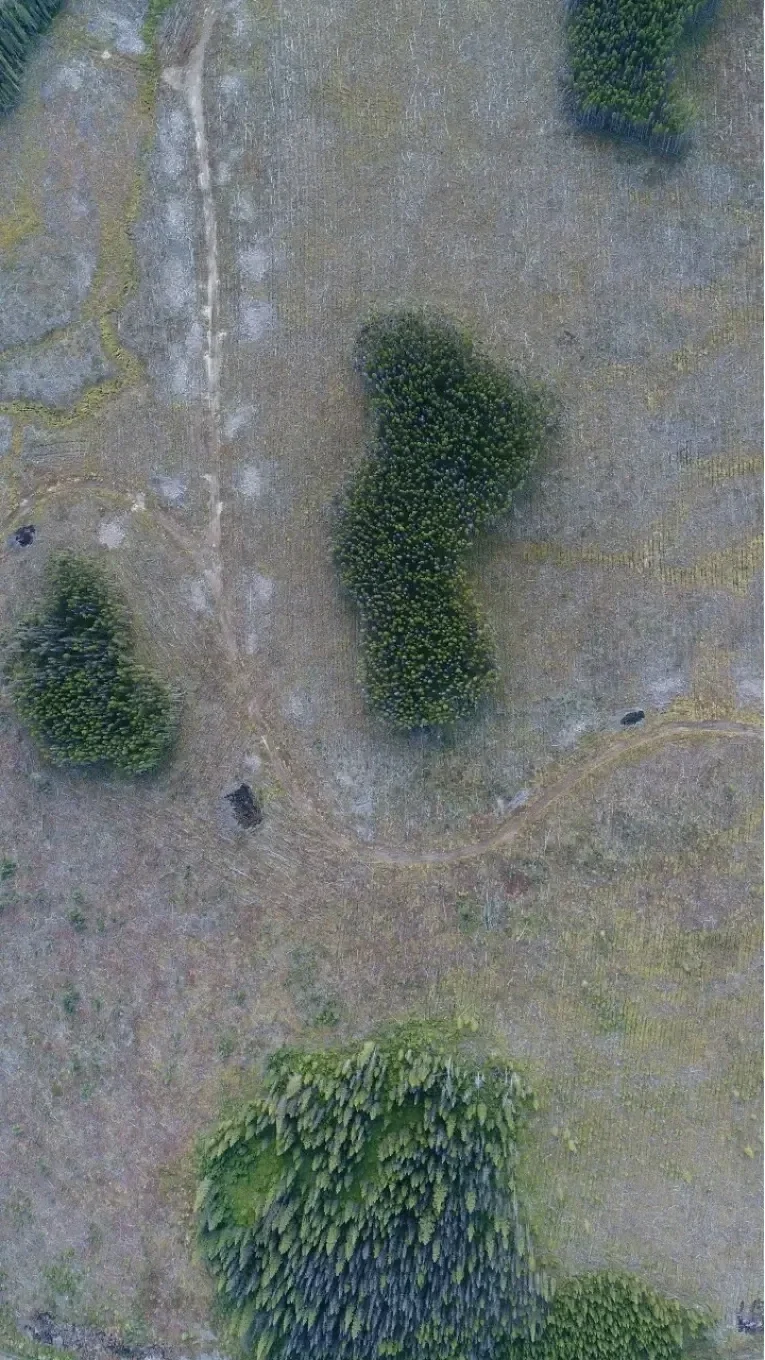
Pinnacle/Drax pellet cutblock for biomass near Burns Lake BC. Credit: Conservation North/Kai Nagata